








3D printing a motor
(Image: MIT)
Researchers in the US are working on a platform that can produce a complete rotary motor in one pass with 3D printing, writes Nick Flaherty.
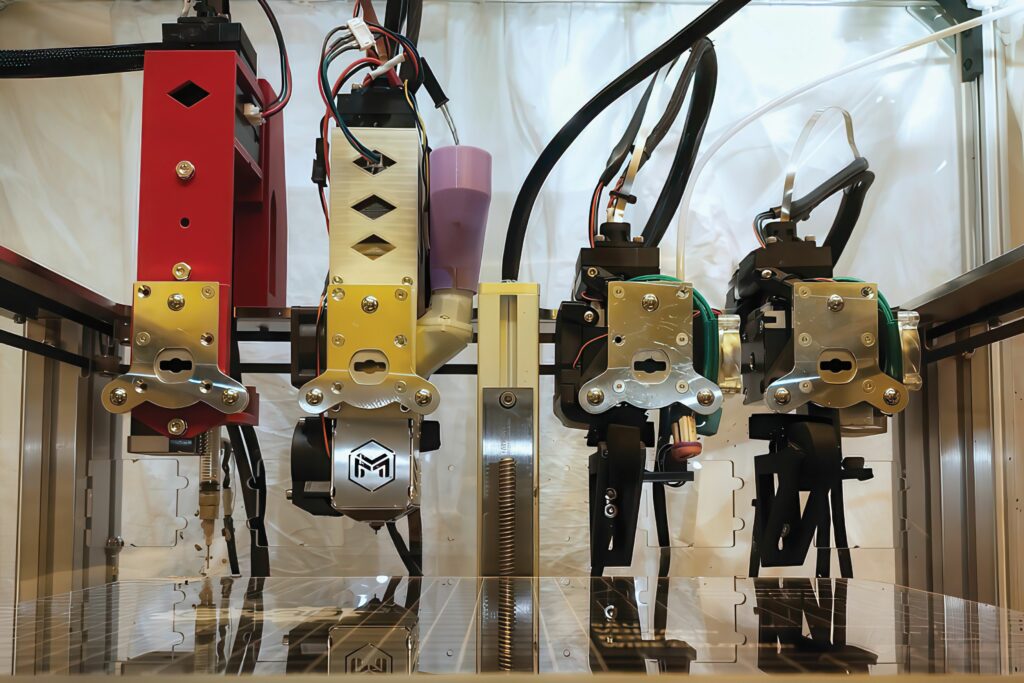
The team at the Massachusetts Institute of Technology (MIT) has already developed a multi-material 3D-printing platform to fully print electric machines in a single step.
The system processes multiple functional materials, including electrically conductive materials and magnetic materials, using four extrusion tools that can handle varied forms of printable material. The printer switches between extruders, which deposit material by squeezing it through a nozzle as it fabricates a device one layer at a time.
The researchers used this system to produce a fully 3D-printed electric linear motor in a matter of hours using five materials, with only one post-processing step for the motor to be fully functional.
The assembled device performed as well or better than similar motors that require more complex fabrication methods or additional post-processing steps.
“This is just the beginning. We have an opportunity to fundamentally change the way things are made by making hardware on site in one step, rather than relying on a global supply chain,” said Luis Fernando Velásquez-García, a principal research scientist in MIT’s Microsystems Technology Laboratories. “With this demonstration, we’ve shown that this is feasible.”
The researchers focused on extrusion 3D printing, with four print heads switching between multiple materials because the device needs an electrically conductive material to carry electric current and hard magnetic materials to generate magnetic fields for efficient energy conversion.
The team carefully designed each extruder to balance the requirements and limitations of the material. For instance, the electrically conductive material must be able to harden without the use of too much heat or UV light because this can degrade the dielectric material.
The researchers used strategically placed sensors and a novel control framework so that each tool is picked up and put down consistently by the platform’s robotic arms, and so that each nozzle moves precisely and predictably. This ensures that each layer of material lines up properly because even slight misalignment could derail the performance of the finished machine.
A demonstration linear motor was fabricated in about three hours and only required the hard magnetic materials to be magnetised after printing to enable full functionality. Total material costs would be about 50 cents per device.
“Even though we are excited by this engine and its performance, we are equally inspired because this is just an example of so many other things to come that could dramatically change how electronics are manufactured,” said Velásquez-García.
The aim is to integrate the magnetisation step into the multi-material extrusion process, demonstrate the fabrication of fully 3D-printed rotary electrical motors and add more tools to the platform for creating more complex electronic devices.
UPCOMING EVENTS