



In conversation: Kofi Owusu-Adusei
(All images: Soko Aerial Robotics)
Man on a mission
The CEO of SoKo Aerial Robotics tells Peter Donaldson of his ambition to address some key problems facing Ghana through application of local UAS technology and talent
With a background in telecoms with an emphasis on security, Kofi Owusu-Adusei, 34, is a Ghanaian engineer and entrepreneur on a mission to solve some of his country’s toughest problems through the application of UAS and the technology ecosystem around them.
He is also a strong believer in home-grown capabilities – tackling African problems with African solutions – although is happy to bring in technology and expertise from around the world when necessary. Owusu-Adusei is the founder and CEO of airborne inspection and survey data provider SoKo Aerial Robotics, and director of the Centre for Unmanned Aerial Vehicles Research and Education (CUAVRE), which is effectively the company’s internal r&d arm.
Established in 2017, SoKo Aerial Robotics has built up a client base in agriculture, mining and infrastructure inspection and is also a contractor to the Ghanaian military. On the civil side, Owusu-Adusei’s most effective strategy for convincing clients to adopt UAS technology has been to shift the conversation from technology to value. “In mining and agriculture, decision-makers respond best to outcomes that directly impact productivity, safety and cost-efficiency,” he explains. “I focus on quantifying tangible returns – such as reduced surveying time, improved yield estimation accuracy and minimised resource wastage. We start every engagement with a pilot project designed to demonstrate measurable ROI [return on investment] within a short timeframe. Once clients see the data and time savings, adoption becomes a natural next step rather than a leap of faith.”
A question of priorities
The investment needed to serve different (but related) markets has to be focused on different combinations of vehicles, sensors and software, so choices have to be made. SoKo prioritises by aligning market demand with technical feasibility and social impact, he says, elaborating that mapping, precision agriculture and infrastructure inspection were chosen because they solve problems that are both high in value and scalable. “We regularly review client needs, regulatory evolution and regional development trends to determine where to deepen or diversify.”
The investments the company makes go beyond buying hardware and software, and Owusu-Adusei emphasises the synergy between SoKo and CUAVRE’s r&d role. This he describes as bridging academic innovation with commercial execution, elaborating that the synergy lies in translating research insights into deployable solutions. “CUAVRE develops and tests new methods for drone operations, analytics and safety management frameworks, which Soko Aerial then operationalises. This relationship keeps Soko Aerial at the frontier of technology while ensuring CUAVRE’s research remains grounded in real-world needs.”
He and the SoKo team have also developed a distinct approach to sourcing technology and finding partnerships for when new developments demand resources beyond what they have in-house – an approach that combines both local and global partnerships with local adaptation. This involves working with local and international hardware and software providers, and an insistence on customising systems for African terrain, weather and connectivity limitations. “I strongly believe the future lies in indigenous solutions – modular drones, locally manufactured components and software built to address local challenges. Building this capability requires collaboration among private firms, research centres and regulators, and that’s precisely where we’re heading.”
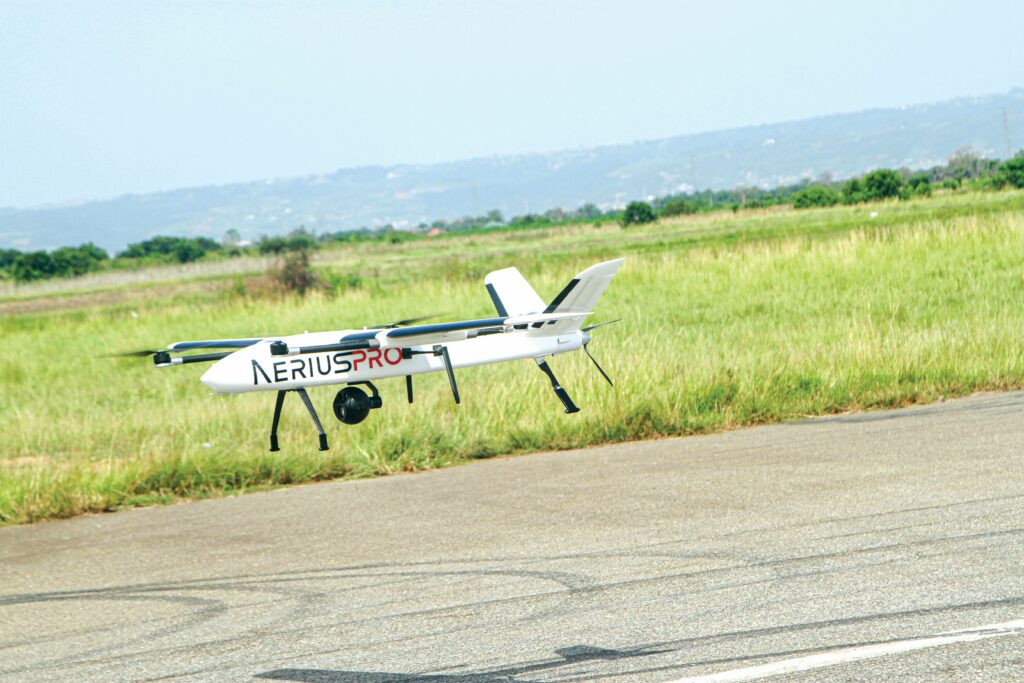
One of these indigenous solutions is the AERIUS PRO, a modular, backpack-portable fixed-wing VTOL machine developed by SoKo and now built by Aerius UAS. The V-tailed drone has four VTOL propellers mounted on under-wing pylons, plus a pusher propeller, and offers up to 3 hours of endurance, 40 km control range, a 4000 m service ceiling and carries a gimbal-stabilised 4K ultra HD video camera. AI-assisted navigation enables intelligent flight modes with obstacle avoidance and automated flight paths. Designed to operate in adverse weather, it is built to the IP43 ingress protection standard.
Full-service ecosystems
To remain competitive in the market for UAS services in Africa takes more than local knowledge, and Owusu-Adusei argues that the company’s principal advantage is its integration of technical depth with contextual intelligence. He emphasises that, as well as flying drones, SoKo designs full-service ecosystems that encompass data processing, analytics and operational safety. The team combines local expertise with a systems-engineering mindset, enabling it to tailor solutions that foreign firms overlook. “It’s this blend of local relevance and operational rigour that defines our competitive edge.”
When hiring people for the SoKo team, he looks for more than technical skills, seeking out curiosity, adaptability and integrity, he says. “The industry evolves rapidly, so we need people who can learn continuously, think critically and collaborate effectively. Beyond skills, I value individuals who share our vision of using technology to solve African problems sustainably.”
Sigtrack situational awareness
A clear example of an African solution to an African problem is the development of Sigtrack, SoKo’s situational awareness and data coordination platform. The system is designed to enable field teams and command centres to maintain real-time visibility of ongoing missions, detect anomalies and make data-driven decisions rapidly. Sigtrack was engineered to function seamlessly in remote, bandwidth-limited regions, distinguishing it from imported command and control systems that depend on centralised networks with broadband links. Sigtrack integrates real-time drone feeds, ground-based intelligence and Internet of Things (IoT) sensor data into a unified operational picture that remains accessible even if it loses communications, syncing automatically when connectivity is restored.
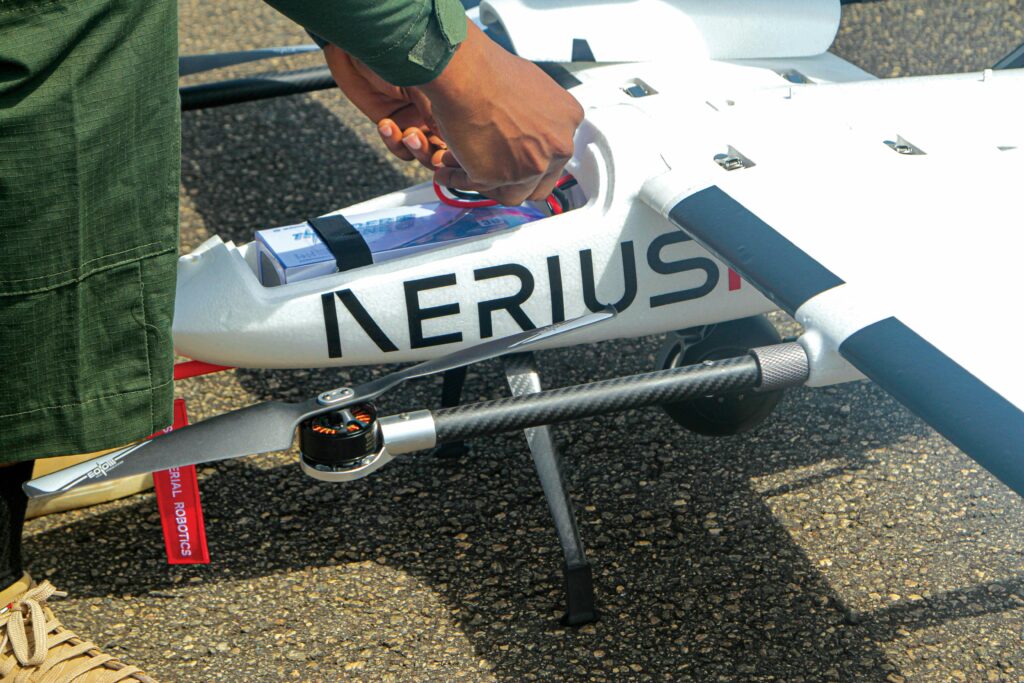
“This capability has transformed how local agencies conduct border surveillance, emergency response and infrastructure security operations,” he says. “Working closely with CUAVRE, we’ve embedded region-specific analytics into the platform – such as terrain mapping, threat pattern recognition and adaptive mission planning – ensuring that Sigtrack not only visualises events but interprets them in context.”
The need to adapt technology for the climate and terrain variations encountered in West Africa has seen SoKo modify UAS hardware for greater thermal resilience and sealing against dust and humidity, and integrate modular sensors suited to local use.
Operationally, flight planning is adapted to altitude, wind patterns and terrain variability, he says, and procedures evolve constantly through field testing to optimise each mission for reliability and data fidelity.
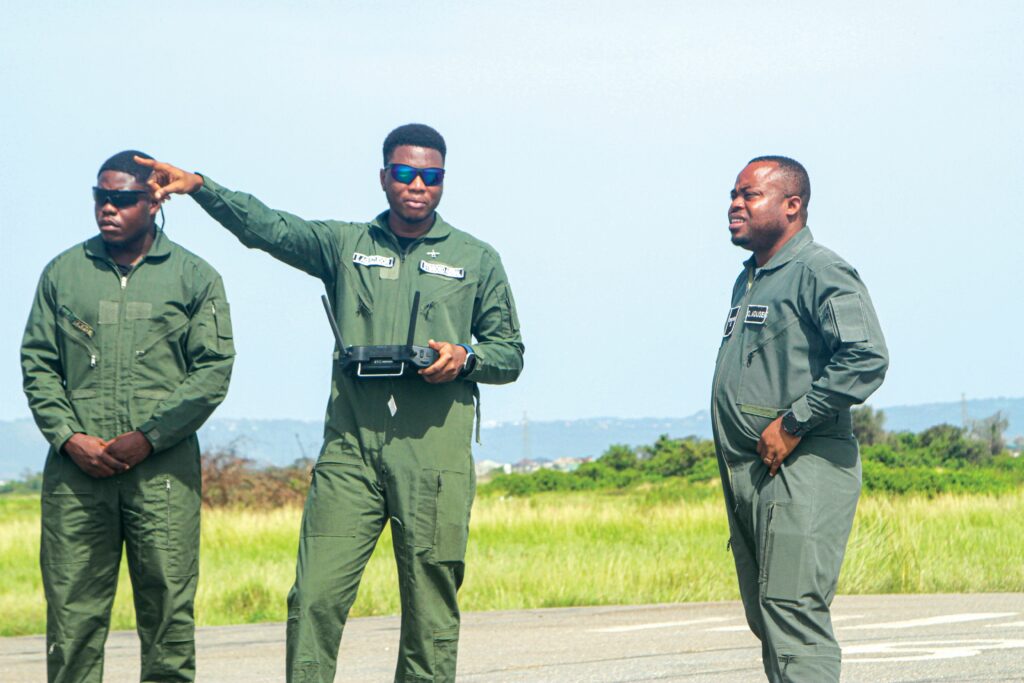
Gathering the data is just the start, and Owusu-Adusei and his team have developed a processing and analytics pipeline designed for precision, reliability and scalability. “Once aerial data are captured, we process them using advanced photogrammetry workflows that automatically align images, generate dense point clouds and produce high-resolution orthomosaics,” he explains. “From these, we derive digital terrain and surface models to create accurate topographic maps used for engineering design, volumetric calculations and agricultural planning. We integrate AI and machine learning algorithms to automate feature extraction, identify surface anomalies and classify land cover types – reducing human error and significantly speeding up data turnaround.”
Standardised operations
Complex operations such as this present many challenges, not least of which is the management, training and quality control of a distributed team of pilots and data analysts working on different projects across the region. The solution SoKo has developed, he says, is a centralised management system that standardises mission planning, safety checks and reporting. “Every pilot and analyst undergoes continuous competency assessment under our training and quality management framework. Regular simulation drills, data audits and safety debriefs ensure uniform standards across all field operations.”
He also stresses that safety is embedded in the company’s culture and processes, explaining that before each operation the team conducts a full risk assessment, develops a safety plan and assigns specific crew roles. “For high-voltage inspections, we implement double redundancy in communications, maintain safe separation distances, and conduct live weather and system checks. Post-mission debriefs and data verification complete the safety cycle.”
His background in communications and computer security helped shape SoKo’s approach to data management, which is designed to instil confidence in customers, especially when working on sensitive projects for large corporations and government agencies. “Data integrity and security are central to our operations,” he emphasises. “We follow protocols for data encryption, access control and client ownership. All client data remain their intellectual property, and we ensure secure storage and controlled access through secure data transfer platforms. Our credibility depends on trust, and we treat that as non-negotiable.”
Many African governments want to foster their own drone industries that both thrive and operate safely, and Owusu-Adusei is a consultant to several, consistently advising them to build policy frameworks that are performance-based rather than prescriptive, stressing that regulation should enable innovation while ensuring safety and accountability. “I encourage governments to adopt sandbox programs, tiered certification and public–private collaboration mechanisms that help startups mature safely within a controlled regulatory environment.”
A sense of mission
His sense of mission, he recalls, stems from the moment he realised that drones could have a fundamental impact in Africa, helping to solve many of the continent’s issues in physical security, food supplies, infrastructure development and making the most of its natural resources. “My background in engineering and telecommunication really did prepare me for this path, but what kept me on track is the hunger for growth and for developing the technology locally.”
SoKo Aerial began as a family-owned business, evolved into a formal startup and is now a fully fledged company in partnership with Ghana’s military – which currently faces terrorist and insurgent threats in the north of the country where it shares a long and porous border with Burkina Faso, exposing it to trouble fomented in the wider Sahel region.
This is not an easy path to take, and encouragement and guidance from mentors is often crucial. He credits Major General Matthew Essien, former commandant of the Ghana Armed Forces Command and Staff College, with a particularly robust piece of advice, which arguably belongs at the ‘tough love’ end of the mentorship spectrum. “I remember him telling me about how the country is counting on me to succeed, and, if I fail, I am letting the Signal Corps and the entire nation down.” He also acknowledges Brigadier General Anthony Ntem for his support and dedication towards expansion of the program and the need to protect it in the national interest.
His personal approach to maintaining focus, he emphasises, is “waking up early, getting to work on time, and getting things done and done right.”
He regards the full-scale deployment of SoKo’s innovations – including AERIUS PRO drones and the Sigtrack situational awareness system – by the Ghanaian military to address the security issues in the north of the country as the most rewarding moment of his career so far.
This achievement is one that should go a long way to correcting one of the greatest misconceptions about the industry in Africa: “Often, many people do not believe in local technical capacity and abilities, assuming that Africans are unable to build these technologies all by themselves.” This is one of his key motivations behind his goals – both professional and personal – to “develop and innovate to protect what matters.”
Asked to choose a global challenge to tackle using uncrewed systems and unlimited resources, he focused on illegal mining. Known as ‘galamsey’ in Ghana, this problem harms peace, stability, security, development, governance, the rule of law, the environment and the economy in many countries, according to the United Nations Office on Drugs and Crime. “I would focus on solving illegal mining and its effect on our environment, and drones are the most practical tools for detecting, monitoring and helping to stop galamsey.”
Kofi Owusu-Adusei
Born in 1991 in Accra, Ghana’s capital and largest city, Kofi Owusu-Adusei grew up in the city’s Madina suburb and attended the Madina SDA primary school. His links with the military began in his junior high school years at the Air Force Basic School, Burma Camp, which prepared him for secondary education at Ghana National College. His higher education began at Ghana Telecom University in Tesano, Accra, where he earned a bachelor’s degree in telecommunications engineering in 2013, followed in 2016 by a master’s in communication technology from Ulm University in Germany, where he also taught mobile communications security and privacy.

He founded Soko Aerial Robotics Group in January 2017 and, within Soko, the Centre for Unmanned Aerial Vehicles Research and Education in February 2019. He also earned a certificate in UAV piloting and control from Arace UAS in the same year. Owusu-Adusei has also been involved with a ride-sharing service – which relies on mobile phone technology – serving as CEO of Lift and Pay from December 2019 to January 2025. Furthering his professional education, he was awarded a Certificate in Military Electronic Warfare by Cranfield University in May 2024, qualifying him as an EW systems integrator.
UPCOMING EVENTS