




8 x 8 cascading radar chip
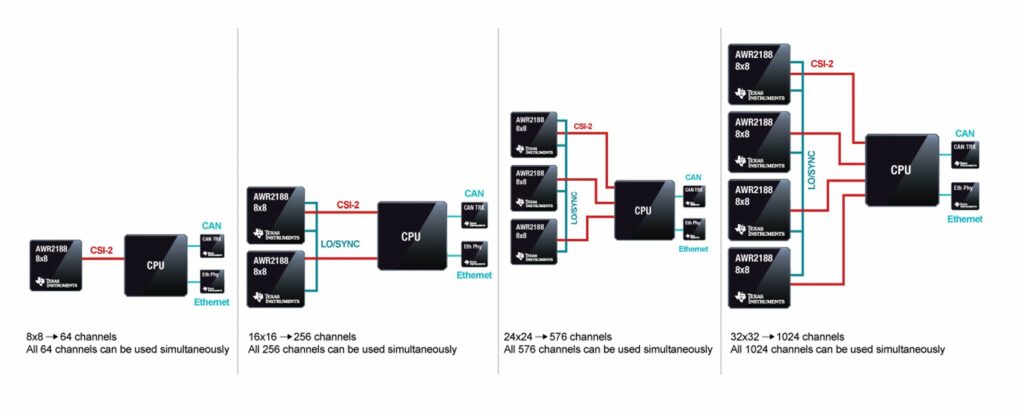
(Image: Texas Instruments)
Texas Instruments has developed a 4D radar chip that can be cascaded easily to extend the sensor reach to 350 m, writes Nick Flaherty.
Along with extending the range of object detection, 4D imaging radar also improves accuracy by using echolocation, which uses radio waves to determine the location, speed and shape of objects in order to monitor environmental and vehicle conditions. Because radio waves have longer wavelengths that can penetrate through particles such as rain, fog and dust, 4D imaging radar has better performance than Lidar or cameras in adverse conditions with poor visibility.
4D imaging radar obtains data from a multiple-input, multiple-output antenna array that facilitates high-resolution mapping. With many antennas transmitting signals to targets within the surrounding environment and receiving signals reflected by those targets, the antenna array generates point-cloud data that translate to improved environmental modelling and object classification.
Implementing 4D imaging radar presents significant challenges for automotive OEMs. Traditional radar systems often require cascading multiple chips to achieve the necessary antenna array size and channel count for high-resolution imaging, increasing system complexity, power consumption and cost. This integration also requires more thermal management and larger printed circuit board footprints, complicating vehicle design and manufacturing.
The AWR2188 4D imaging radar transceiver integrates eight transmitters at 76–81 GHz and eight receivers into a single, self-calibrating package. The chirp bandwidth, or continuous frequency sweep that is up to 4.5 GHz, comes from a chirp engine based on a fractional-N phase locked loop. The minimum chirp idle time of 3 μs allows maximum velocity measurements with a maximum chirp slope of 266 MHz/μs to enable rapid high-bandwidth measurements.
Cascading these devices helps designers achieve even higher performance and more accurate long-range object detection at over 350 m, while providing a scalable development path from cost-effective stand-alone implementations to premium radar systems.
UPCOMING EVENTS